|
The
3 spacecraft launched in 1957:
.
Spacecraft
Entries
.
Pre-Sputnik flight
| Notes: |
In September 1956, the U.S. Army launched
a Jupiter C missile from Cape Canaveral that could have put a satellite
into orbit if it had included a live third stage. |
| Source: |
Asif Siddiqi, Challenge
To Apollo, p. 153 ; |
|
|
.
.
Sputnik / PS 1
| Spacecraft: |
Note: at the time of its launch,
this spacecraft was simply called “the first artificial Earth satellite”;
the name Sputnik was applied much later. (Russian technicians called
it: 1-y ISZ - 1st Soviet sputnik.) PS stands for
Russian's “Prostreishiy Sputnik,” which means the simplest satellite (as
opposed to Object D (Sputnik
3) that was supposed to be launched first). |
| Chronologies: |
1957 payload #1 ; 1957-001A (1957 Alpha 2)
; 1st spacecraft ; 2nd space
object catalogued.* |
| Type: |
Technology |
Significant
achievements: |
| • |
1st man-made object placed into
orbit around Earth.
(Many sounding rockets had alreadu flown
at altitude higher than this first satellite.) |
| • |
Sputnik launched the Space Age and started
the Space Race between the United States and the Soviet Union. |
| • |
Spacecraft 8 times heavier than U.S.-planned
Vanguard satellites. |
| • |
1st try and 1st success of a satellite's
launch. (There were no previous failure.) |
|
| Sponsor: |
Soviet Union (Korolev's Design Bureau) |
|
 |
| Launch: |
4 October 1957 at 19h28 UT, from
Baykonur Cosmodrome's LC-1, by an A/"Sputnik".
(Formerly: a SL-1 rocket launched from Tyuratam.) |
| Orbit: |
| 228 km x 946 km x 65.° x
96 min. |
A&A |
| 228 km x 947 km x 65.1° x 96.17 min. |
ESAM |
| 227 km x 947 km x 65.1° x 96.2 min. |
SSP |
| 215 km x 939 km x 65.1° x 96.2 min. |
TRW |
| 227 km x 945 km x 65.0° x 96.10 min. |
Wade |
|
| Decayed: |
3 or 4 January 1958 (after 92 days). |
| Mission: |
TASS news agency announcement: “For
several years, research and experimental designing work had been under
way in the Soviet Union to create artificial satellite of the Earth. It
has already been reported in the press that the launching of the Earth
satellite in the U.S.S.R. was planned in accordance with the program of
the International Geophysical Year research.
At a result of the
intensive work of research institutes and designing bureaus, the first
Earth artificial satellite in the world has now been created. This first
satellite was successfully launched in the U.S.S.R. on Oct. 4.
According to the
preliminary information, the carrier rocket has imparted to the satellite
the required orbital velocity of about 8,000 meters a second. At the present
time, the satellite is describing elliptical trajectory around the Earth.
Its flight will be observed in the rays of the rising and setting sun with
the aid of the simplest instruments such as binoculars and spy-glasses.
According to the
circulations which are being supplemented by direct observation the satellite
will travel at altitudes up to 900 kilometers above the surface of the
Earth. A complete revolution of the satellite will take one hour and thirty-five
minutes. Its orbit is inclined at an angle of 65 degrees to the equator
plane. Tomorrow the satellite will pass twice over the Moscow area, at
1:46 A.M. and at 6:42 A.M. Moscow time.
Reports about the
subsequent movement of the first artificial satellite launched in the U.S.S.R.
on the 4th of October will be issued regularly by the Soviet broadcasting
stations.
The satellite is
of spherical shape, fifty-eight centimeters in diameter and weight 83.6
kilograms. It is fitted with steel radio transmitters continuously emitting
signals at a frequency of 20.005 and 40.002 megacyles or 15 and 7.5 meters
wavelengths respectively.
The power of the
transmitter is such to assure reliable reception by a broad range of amateurs.
The signals are of the nature of the telegraphic signals at about zero
point three second durations with a pause of the same duration. The signals
of one frequency are send during the pause of the signals of the other
frequency.
Scientific stations
at various points in the Soviet Union are conducting observation of the
satellite and determining elements of its trajectory. Since the density
of the atmosphere is not accurately known, there are no data available
at the present for determining the exact period of the satellite’s existence
or to the point of its reentry into the denser layer of the atmosphere.
Calculations have
shown that owing to the tremendous velocity of the satellite at the end
of its existence, it will burn up on reaching the denser layer of the atmosphere
at an altitude of several scores of kilometers.
The possibility
of cosmic flight with the help of rockets was first scientifically substantiated
in Russia, as early as the end of the nineteenth century, in the work of
the outstanding Russian scientist Konstatin Tsiolkovsky.
The successful launching
of the first man-made Earth satellite makes tremendous contribution to
the treasure house of the world science and culture. The scientific experiment
staged at such a great height is of great importance to fathoming the properties
of cosmic space and for studying earth as part of our solar system.
The Soviet Union
proposes to send up several more artificial satellite during the International
Geophysical Year. These will be the bigger and heavier and will help to
carry out an extensive program of scientific research.
Artificial Earth
satellites will pave the way for space travel and it seems that the present
generation will witness how the freed and conscious labor of the people
of the new socialist society turn even the most daring of man’s dreams
into a reality.”
Sputnik I: 1st manmade
Earth satellite. Total weight in orbit: about 4 tons (unofficial) and scientific
instrumentation: 83 kg. Transmitters ceased on 24 October 1957). Payload
down on 4 January 1958, after 92 days. (A&A, 1961)
* * * * *
“Rumors of an impending
launch, perhaps in time to celebrate Tsiolkovskiy's birthday on September
17, 1957, began to circulate in Moscow. Although this did not happen, the
rumors grew more positive in the first week of October. Even so, the Sputnik
shock of Octoer 4 has become a classic case. Not only laymen, but many
technical people were caught by surprise with the Soviet announcement of
the first satellite. Launched from an unspecified point, it circled the
Earth every 96 minutes at an inclination of 65 degrees to the Equator,
which meant it passed overhead of most of the inhabited world. It broadcast
on two harmonic frequencies close to 20 and 40 megahertz. Battery powered,
variations of its cricket-like beeping signal both revealed characteristics
of the ionosphere and told of its own temperature changes. Its variations
in orbit and eventual decay revealed something of atmospheric density.
But its announced weight of 83.6 kilograms, an order of magnitude greater
than the planned American satellite, suggested to a number of scientists
that a decimal place had been in error. There were still others who could
not accept the notion the Soviet Union could be first in a field of advanced
technology and they invented elaborate schemes for explaining Soviet trickery
to simulate a satellite which they felt did not exist in fact. It also
became popular to believe there were constant Soviet attempts to launch
which generally failed, and that whatever had been put up was necessarily
crude and only for propaganda purposes, and in any ease was built by Germans
or stolen from the United States. The assessments were wide of the mark.
The first three
Sputniks were put up by the same original ICBM system. The whole boostor
core vehicle was in orbit, with its weight of about 6 metric tons, measuring
28 meters long, slowly tumbling end over end, almost the size of a railway
Pullman sleeper. It was this big rocket which was most easily identified
on its passage across the night sky by observers in every continent.” (SSP
1971-75, 1976)
* * * * *
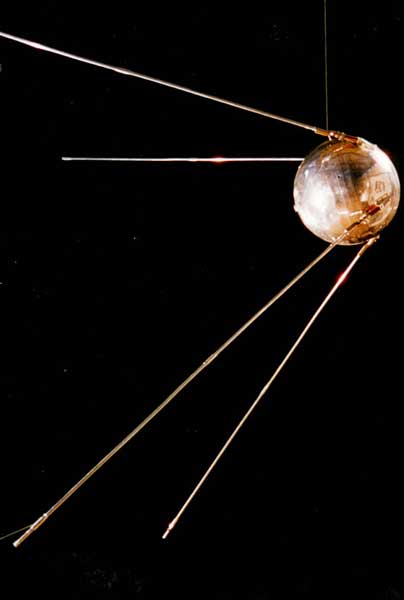
Current overview: Sputnik was the first
artificial satellite successfully placed in orbit around the Earth and
was launched from the "Baykonur Cosmodrome" at Tyuratam (370 km southwest
of the small town of Baykonur) in Kazakhstan. The Russian word "Sputnik"
means "companion" ("satellite" in the astronomical sense). It was a 58-cetimeter
diameter aluminum sphere that carried four whip-like antennas that were
2.4 to 2.9 meters long. On-orbit dry mass: 83.60 kg. The antennas looked
like long "whiskers" pointing to one side. The instruments and electric
power sources were housed in a sealed capsule and included transmitters,
the emissions taking place in alternating groups of 0.3 second in duration.
The downlink telemetry included data on temperatures inside and on the
surface of the sphere. The satellite transmitters operated for three weeks,
until the on-board chemical batteries failed, and were monitored with intense
interest around the world. The spacecraft obtained data pertaining to the
density of the upper layers of the atmosphere and the propagation of radio
signals in the ionosphere. This first satellite revealed characteristics
of the ionosphere through variations in its beeping signal, and its orbital
variations and eventual decay provided information on atmospheric density.
The small but highly
polished sphere was barely visible as a sixth magnitude object and was
more difficult to follow optically than the rocket booster (which is the
1st space object catalogued) that also reached Earth orbit and was visible
from the ground at night as a first magnitude object. Sputnik decayed 92
days after is launch, having completed about 1400 orbits around the Earth
over a cumulative distance traveled of 70 million kilometers. The satellite
and the launcher were developed by Sergei Korolyov's design bureau at NII-88/Podlipki
(now RKK-Energiya). |
| Notes: |
The 8K71PS launch vehicle (also designated
"A" or "Sputnik") is a minor modification
of the experimental 8K71 R-7 ICBM. The launch vehicle earmarked for the
satellite was a slightly uprated version of the basic 8K71 ICBM variant,
renamed the 8K71 PS. The modifications included omitting the 300-kilogram
radio package from the top of the core booster, changing the burn times
of the main engines, removing a vibration measurement system, using a special
nozzle system to separate the booster from the satellite installed at the
top of the core stage, and installing a completely new payload shroud and
container, which replaced the warhead configuration. The length of the
booster with the new shroud was 29.167 meters, almost four meters shorter
than the ICBM version. Because there was some doubt as to whether ground
observers would be able to observe the tiny satellite in orbit, Korolev
ensured that the central core of the launch vehicle was sufficiently reflective.
“As the seconds
counted down to zero, and Nosov shouted the command for liftoff. Chekunov
immediately pressed the launch button. At exactly 2228 hours, 34 seconds,
Moscow Time, the engines ignited, and the 272,830-kilogram booster lifted
off the pad in a blaze of light and smoke. The five engines of the R-7
generated about 398 tons of thrust at launch. Although the rocket lifted
off gracefully, there were problems. Delays in the firing of several engines
could have easily resulted in a launch abort. Second, at T+16 seconds,
the Tank Emptying System malfunctioned, resulting in a higher than normal
kerosene consumption. A turbine failure because of this resulted in main
engine cutoff one second prior to the planned moment. Separation from the
core stage, however, occurred successfully at T+324.5 seconds, and the
83.6-kilogram PS-1 successfully fell into a free-fall elliptical trajectory.
The first human-made object had entered orbit around Earth. A new era had
begun. The Soviet media did not ascribe a specific name for the satellite,
generally referring to it as Sputnik, the Russian word for "satellite,"
often also loosely translated as "fellow traveler."” |
| Sputnik origins: |
The first Soviet satellite to be launched
was the 1-tonne "Object D".
But delays that occured during 1956 prompted Korolev to ordered, on 25
November 1956, a young engineer at OKB-1, Nikolay Kutyrkin, to begin designing
a new smaller satellite. Another young man, Georgiy
Grechko (a twenty-six-year-old engineer who would fly into space from
the same site eighteen years later), set about calculating preliminary
ballistics on the launch. On January 5, 1957, Korolev asked for permission
to launch two small satellites, each with a mass of forty to fifty kilograms,
during the period of April-June 1957, that is immediately prior to the
beginning of the International Geophysical Year. Each satellite would orbit
Earth at attitudes of 225 to 500 kilometers and contain a simple shortwave
transmitter with a power source sufficient for ten days of operation. By
January 25, 1957, Korolev had approved the initial design details of the
satellite officially designated the Simple Satellite No. 1 (PS-1). On February
15, the USSR Council of Ministers formally signed a decree (no. 171-835s)
titled "On Measures to Carry out in the International Geophysical Year,"
agreeing to the new proposal. The two new satellites, PS-1 and PS-2, would
weigh approximately 100 kilograms and be launched in April-May 1957, after
one or two fully successful R-7 ICBM launches. Meanwhile, the Object D
launch was pushed back to April 1958. In the summer, Korolev, Glushko,
and the other chief designers had informally targeted the satellite launch
for the 100th anniversary of Tsiolkovskiy's birth on September 17th, but
achieving this date proved increasingly unrealistic. |
| Source: |
Jonathan
Space Report's Master
List ; Mark
Wade’s Encyclopedia Astronautica's 1957
Chronology ; National Space Science
Data Center's 1957-001B
; Aeronautics
and Astronautics, 1915-1960, p, 91, 140 ; Encyclopédie sociétique
de l'astronautique mondial, 1971, Annexe 1 ; Congressional Research
Service, Soviet Space Program 1971-75, 1976, p. 82-3, 84, 554 ;
TRW
Space Log 1996 (Vol. 32), p. 65 ; Asif Siddiqi,
Challenge
To Apollo, p. 154-5, 164, 165, 167 ; Gunter's
Sputnik
1 (PS-1 #1) : Celestrak's Satcat=1957
; |
|
|
..
Sputnik 2 / PS 2
| Spacecraft: |
Note: at the time of its launch,
this spacecraft was simply called “the second artificial Earth satellite”;
the name Sputnik 2 was applied much later. (Russian technicians called
it: 2-y ISZ - 2nd Soviet sputnik.) PS stands for
Russian's “Prostreishiy Sputnik,” which means the simplest satellite. |
| Chronologies: |
1957 payload #2 ; 1957-002A (1957 Beta 1)
; 2nd spacecraft ; 3rd space
object catalogued.* |
| Type: |
Technology,
Earth/space
Sciences and biology |
Significant
achievements: |
| • |
1st living being placed in Earth
orbit; dog Laika. |
| • |
Multi-purpose science satellite. |
| • |
Spacecraft 50 times heavier than U.S.-planned
Vanguard satellites. |
|
| Sponsor: |
Soviet Union (Korolev's Design Bureau) |
|
 |
| Launch: |
3 November 1957 at 2h31 UT, from
Baykonur Cosmodrome's LC-1, by an A/"Sputnik".
(Formerly: a SL-1 rocket launched from Tyuratam.) |
| Orbit: |
| 225 km x 1,670 km x 65° x
103.7 min. |
A&A |
| 225 km x 1,671 km x 65.3° x 103.75 min. |
ESAM |
| 225 km x 1,621 km x 65.3° x 103.7 min. |
SSP |
| 212 km x 1,660 km x 65.3° x 103.7 min. |
TRW |
| 212 km x 1,660 km x 65.3° x 103.70 min. |
Wade |
|
| Decayed: |
14 April 1958 (after 162 days). |
| Mission: |
First TASS news agency announcement:
“The second Earth artificial satellite was launched in the Soviet Union
on 3rd November. According to the available information, it represents
the last stage of the carrier rocket housing containers with scientific
instruments and radio transmitters.
The containers with
apparatus weight 508.3 kilograms. The satellite carries a container with
an experimental animal.
The satellite had
been given an orbital velocity of about 8,000 meters per second. Its maximum
distance from the Earth exceed 1,500 kilometers. The time of a complete
circuit around the Earth is approximately 102 minutes.”
Second TASS Announcement: “In conformity
with the International Geophysical Year program for studying the Earth
upper layers of the atmosphere as well as the physical processes and conditions
of life in cosmic space, the second artificial Earth satellite was launched
in the Soviet Union on 3rd November.
The second artificial
satellite developed in the U.S.S.R. represents the last stage of the carrier
rocket housing containers with scientific instruments.
The second artificial
satellite carries instruments for studying solar radiation in the short
wave ultra violet and X-ray regions of the spectrum, instruments for cosmic
ray studies, instruments for studying the temperature and pressure, and
airtight container with an experimental animal, an air conditioning system,
food and instruments for studying life processes in the conditions of cosmic
space, measuring instruments for transmitting the results of scientific
instruments to the Earth, two radio transmitters operating on frequencies
of 40.002 and 20.005 kilocycles and the necessary power sources.
The total weight
of the apparatus mentioned above, the experimental animal and power sources
amount to 508.3 kilograms.
According to observations,
the satellite has been given an orbital velocity of about 8,000 meters
per seconds.
According to calculations
which are being verified at present by direct observations, the maximum
distance of the satellite from the Earth’s surface exceeds 1,500 kilometers.
The time of one
complete circuit is about one hour 42 minutes. The angle of the incline
of the orbit to the plane of equator is approximately 65 degress.
According to the
information received from the satellite, the scientific instruments and
control of the life processes of the animal are proceeding normally.
On 3rd November,
the second artificial satellite passed over Moscow at 7:20 A.M. and will
appear again at 9:05 A.M.
The signal of the
satellite’s radio transmitter on the 20.005 kilocycles are given in the
form of telegraph beats lasting about 0.3 seconds with a pause of equal
duration. The 40.002 kilocycles transmitter emits continually.
By the successful
launch of the second artificial Earth satellite with diverse scientific
instruments and an experimental animal, Soviet scientists are extending
the program of studying cosmic space and upper layers of the atmosphere.
The unfathomed natural proceses going on in the cosmos will now become
more understandable to man.
The workers of research
institutes, designing bureaus, the testers and industry workers who created
the second Soviet artificial satellite of the Earth dedicate its launching
to the fortieth anniversary of the great October Socialist revolution.”
Sputnik II experiments:
cosmic rays, solar ultraviolet and X-radiation; test animal “Laika”. Total
weight in orbit: about 4 tons (unofficial), and scientific instrumentation:
510 kg. Transmitters ceased on 10 November 1957. 1st biomedical experiment
and data, disclosed significant solar influence on upper atmosphere densities.
Down on 14 April 1958, after 162 days. (A&A, 1961)
On 27 April 1958,
Pravda
reported on Soviet satellite findings that Laika’s heartbeat had taken
three times as long as expected to return to normal. Weightlessness affecting
the nerve centers was suggested as the cause. The Soviet report disclosed
that the density and temperature of the atmosphere at a given altitude
were not uniform, and that cosmic ray intensity was 40 percent greater
at 650 km than at 210 km.
* * * * *
“While the first Soviet
satellite was a bad shock, its simple structure, limited battery power
and lack of instrumentation (other than its beacons) could be contrasted
with the more elaborate, miniaturized instrumentation promised for Vanguard.
However, on November 3, 1957, the second Soviet payload placed in orbit
was announced as weighing 508.3 kilograms, and it carried a respectable
range of geophysical instrumentation. Also, it contained a life support
system and returned biomedical data for a week from the dog Layka. This
supplied basic data for planned manned flights. The life support system
showed it could function remotely. Data were returned on the effects of
weightlessness and G load during launch, on radiation, and on temperature
changes. Sensors measured some kinds of radiation and micrometeorite impacts.
Also, the Russians revealed what was evident to visual observers: the payload
remained attached to a much larger spent rocket casing, so that the total
weight was probably on the order of 6.5 metric tons.
The first three
Sputniks were put up by the same original ICBM system. The whole boostor
core vehicle was in orbit, with its weight of about 6 metric tons, measuring
28 meters long, slowly tumbling end over end, almost the size of a railway
Pullman sleeper. It was this big rocket which was most easily identified
on its passage across the night sky by observers in every continent.” (SSP
1971-75, 1976)
* * * * *
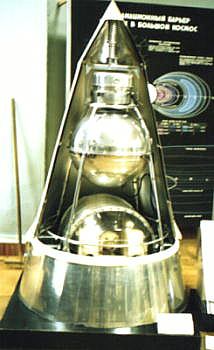 Current
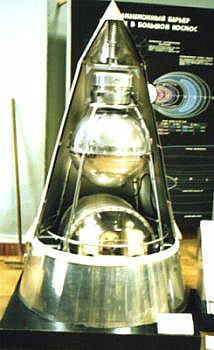
overview: Sputnik 2 was the first biological spacecraft, carrying a
dog. It was a 4-meter high cone-shaped capsule with a base diameter of
2 meters, weighinbg 508.30 kg. It contained several compartments for radio
transmitters, a telemetry system, a programming unit, a regeneration and
temperature control system for the cabin, and scientific instruments for
measuring solar radiation (ultraviolet and x-ray emissions) and cosmic
rays. A separate sealed cabin contained the experimental dog Laika - a
stray-dog found on the streets of Moscow. A television camera was mounted
in the passenger compartment to observe Laika. The camera could transmit
100-line video frames at 10 frames/second. The spacecraft provided data
on the behavior of a living organism in the space environment. Current
overview: Sputnik 2 was the first biological spacecraft, carrying a
dog. It was a 4-meter high cone-shaped capsule with a base diameter of
2 meters, weighinbg 508.30 kg. It contained several compartments for radio
transmitters, a telemetry system, a programming unit, a regeneration and
temperature control system for the cabin, and scientific instruments for
measuring solar radiation (ultraviolet and x-ray emissions) and cosmic
rays. A separate sealed cabin contained the experimental dog Laika - a
stray-dog found on the streets of Moscow. A television camera was mounted
in the passenger compartment to observe Laika. The camera could transmit
100-line video frames at 10 frames/second. The spacecraft provided data
on the behavior of a living organism in the space environment.
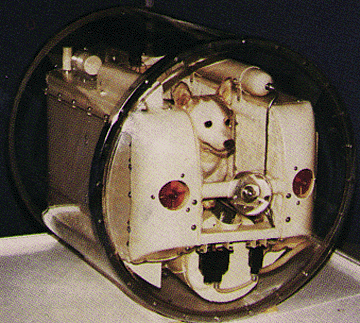 The first being to travel to outer space was a female part-Samoyed terrier
originally named Kudryavka (Little Curly) but later renamed Laika (Barker).
She weighed about 6 kg. The pressurized cabin on Sputnik 2 allowed enough
room for her to lie down or stand and was padded. An air regeneration system
provided oxygen; food and water were dispensed in a gelatinized form. Laika
was fitted with a harness, a bag to collect waste, and electrodes to monitor
her vital signs. The early telemetry indicated Laika was agitated but eating
her food. There was no capability of returning a payload safely to Earth
at this time, so it was planned that Laika would run out of oxygen after
about 10 days of orbiting the Earth.
The first being to travel to outer space was a female part-Samoyed terrier
originally named Kudryavka (Little Curly) but later renamed Laika (Barker).
She weighed about 6 kg. The pressurized cabin on Sputnik 2 allowed enough
room for her to lie down or stand and was padded. An air regeneration system
provided oxygen; food and water were dispensed in a gelatinized form. Laika
was fitted with a harness, a bag to collect waste, and electrodes to monitor
her vital signs. The early telemetry indicated Laika was agitated but eating
her food. There was no capability of returning a payload safely to Earth
at this time, so it was planned that Laika would run out of oxygen after
about 10 days of orbiting the Earth.
After reaching orbit,
the nose cone was jettisoned successfully but the Blok A last-stage of
the booster did not separate as planned. This inhibited the operation of
the thermal control system. Additionally, some of the thermal insulation
tore loose so the interior temperatures reached 40°C. Doctors monitoring
Layka in day following the launch began to notice a significant rise in
the internal temperature of the biological compartment, apparently a result
of inefficiencies and malfunctions in the spacecraft's thermal control
system. For almost the entire period of her flight, Layka suffered a modicum
of discomfort because of these high temperatures. The poor dog finally
succumbed to heat exhaustion on the fourth day of the mission on November
7. [As least as late as1980, it was reported (in USCSP p. 721) that “Laika
was poisoned after one week in orbit.”) Later analysis on the ground based
on incoming telemetry confirmed the suspicions of doctors that overheating
had in fact caused her death. Since Sputnik 2 had no descent capsule, the
dog burned up along with the satellite as it returned to the Earth's atmosphere
after 162 days in orbit.
The Soviets revealed
one striking piece of information unrelated to Layka many years later.
The scientific instruments on the PS-2 had performed without any problems
for a week and had detected evidence for the existence of a radiation belt
around Earth. Soviet scientists on the ground who studied the data were,
however, "circumspect in their interpretations" of the information. In
the end. the first U,S. satellite,
Explorer
1, returned the same data a few months later, and the United
States claimed one of the great discoveries of the early space age: the
existence of a continuous band of radiation belts around Earth, the van
Allen radiation belts. |
Origins of
Sputnik 2 |
“Korolev, who returned to Moscow on 5 October
1957 after the successful launch of Sputnik 1, elected
to play with an ambitious idea to sustain the successes of the new space
program. Soviet leader Khrushchev immediately called him to find out all
the details of the Sputnik launch. During the conversation,
he asked casually whether Korolev could launch another satellite, possibly
in time for the 40th anniversary of the Great October Socialist Revolution
on November 7. Without any hesitation, Korolev suggested that his team
could launch a dog. Khrushchev was ecstatic about the idea, stipulating
only that the launch had to take place by the holiday. The official order
for the launch was issued on October 12, 1957, eight days after the launch
of the first Sputnik. The new satellite was designated Simple Satellite
No. 2 (PS-2), later named the "Second Artificial Satellite" in the Soviet
press. Technical operations on the construction of the PS-2 formally began
on October 10. No provision was made to return the dog from orbit because
neither the technology nor the time was available to prepare for such a
mission. Doctors expected to put the animal to sleep with an automated
injection of poison prior to oxygen depletion in the life support system.
The total mass of the payload was 508 kilograms, a significant leap from
the modest 84-kg PS-1.” |
| Source: |
Jonathan
Space Report's Master
List ; Mark
Wade’s Encyclopedia Astronautica's 1957
Chronology ; National Space Science
Data Center's 1957-002A
; Aeronautics
and Astronautics, 1915-1960, p. 91, 98, 140 ; Encyclopédie
sociétique de l'astronautique mondial, 1971, Annexe 1 ; Congressional
Research Service, Soviet Space Program 1971-75, 1976, p. 83, 84,
173-4, 554 ; United States Civilian Space Program, 1958-1978, Vol.
1, 1981, p. 721 ; TRW Space Log 1996 (Vol. 32), p. 65 ; Asif Siddiqi,
Challenge
To Apollo, p. 171-2, 173, 175 ; Gunter's
Sputnik
2 (PS-2 #1) : Celestrak's Satcat=1957
; |
|
|
.
Vanguard TV-3
| Spacecraft: |
Vanguard TV-3 / Vanguard Test
Satellite |
| Chronologies: |
1957 payload #3 ; 1957 1st loss ; 3rd spacecraft. |
| Type: |
Technology |
Significant
achievements: |
| • |
1st attempt by the United States
to launch a satellite (failed). |
| • |
Was supposed to be a launcher test but, following
the orbiting of the two Sputniks, it became a satellite launch attempt. |
| • |
Since the launch was made in full view, it
became a spectacular blow to the U.S. national prestige. |
| • |
The beginning of the Space Race between the
United States and the Soviet Union. |
|
| Sponsor: |
U.S. NRL / Naval Research Laboratory |
|
 |
| Launch: |
6 December 1957 at 16h45 UT,
from Cape Canaveral Air Force Station's LC-18A, by a Vanguard. |
| Orbit: |
None. |
| Destroyed: |
6 December 1957. |
| Mission: |
Historical reports: On 29 July 1955,
the United States announced it would launch earth satellites during the
18-month International Geophysical Year, which ended formally on 31 December
1958. After proposals from the three military services had been studied,
the Government approved a Naval Research Laboratory plan for constructing
a three-stage rocket capable of placing a spherical, 9.75-kg, instrumented
satellite in orbit. The program, which came to be known as Project Vanguard,
also called for establishing a worldwide Minitrack network to track space
vehicles by radio.
The Vanguard rocket
is tall (22 metres) and slim (11.4 cm) in diameter at the base) with a
gross take-off weight of 10.2 tons. It consists of liquid propellant first
and second stages and a solid propellant third stage. The second stage
contains the rocket's guidance and control system.
Three successive test firings
of Vanguard's first and third stages were successful. However, the three
stages in combination failed when test-fired for the first time on 6 December
1957. (USASA, 1959)
* * * * *
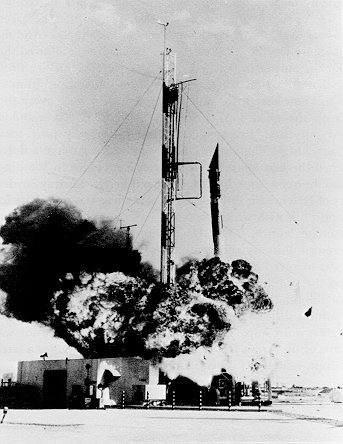 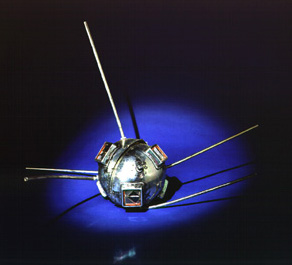 Current
overview: First U.S. orbital attempt. The Vanguard TV-3 launcher was
the first with three live stages. It failed to launch a test satellite
weighting 1.35 kg - a small "test" satellite without a scientific payload
but carrying a radio transmitter- , when it lost thrust after only 2 seconds
after liif-off. Its spectacular failure was witnessed by an international
assemblage of reporters and observers, the largest group ever to assemble
for the purpose of witnessing a launch - a further blow to national prestige..
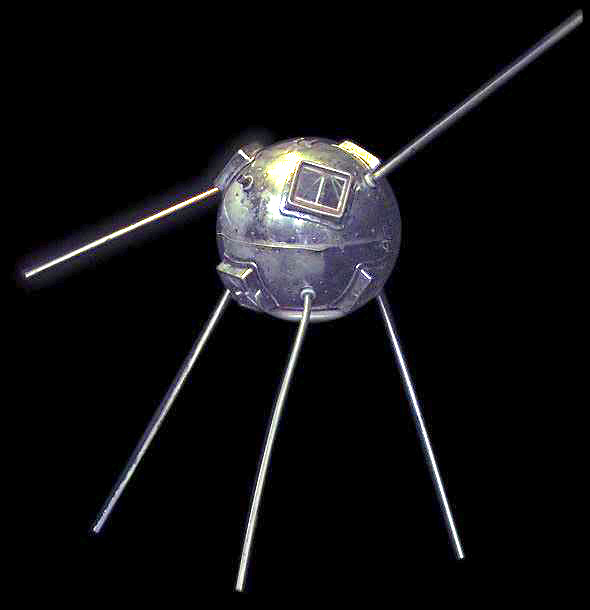
The satellite was thrown clear from the explosion and is now on display
at the Smithsonian
Air and Space Museum in Washington D.C. Current
overview: First U.S. orbital attempt. The Vanguard TV-3 launcher was
the first with three live stages. It failed to launch a test satellite
weighting 1.35 kg - a small "test" satellite without a scientific payload
but carrying a radio transmitter- , when it lost thrust after only 2 seconds
after liif-off. Its spectacular failure was witnessed by an international
assemblage of reporters and observers, the largest group ever to assemble
for the purpose of witnessing a launch - a further blow to national prestige..
The satellite was thrown clear from the explosion and is now on display
at the Smithsonian
Air and Space Museum in Washington D.C. |
| Origins of the Vanguard program: |
In the spring of 1955, scientific interest
in orbiting an artificial Earth satellite for International Geophysical
Year (IGY, 1st July 1957 to 31 December 1958) was growing. Several launch
vehicle proposals were developed for placing a U.S. satellite in orbit.
The proposal chosen in August 1955 to be the U.S. satellite project for
the IGY was the one offered by the Naval Research Laboratory (NRL), based
on Milton W. Rosen's concept of a new launch vehicle combining the Viking
first Stage, Aerobee second stage, and a new third stage. Rosen became
technical director of the new project at NRL.
The name "Vanguard"
applied to both the first satellite series undertaken by the United States
and to the launch vehicle developed to orbit
the satellites. It was suggested by Rosen's wife, Josephine. Rosen forwarded
the name to his NRL superiors, who approved it. The Chief of Naval Research
approved the name 16 September 1956. The word denoted that which is "out
ahead, in the forefront."
On 19 May 1971,
the Vanguard satellite, which had been thrown clear when vehicle exploded
on pad, was presented to National Air and Space Museum, Smithsonian Institution,
by Dr. John P. Hagen, former director of U.S. IGY satellite program . |
| Source: |
Jonathan
Space Report's Master
List ; Mark
Wade’s Encyclopedia Astronautica's 1957
Chronology and Vanguard
page ; National Space Science Data
Center's VAGT3
; United States Aeronautics
and Space Activities, 1st Annual Report to Congress, 1959, p. 6
; Aeronautics
and Astronautics, 1915-1960, p. 92 ; TRW Space Log 1996 (Vol.
32), p. 65 ; Vanguard,
A History (NASA SP-4202) Chapter
11 ; NASM Vanguard
article ; KSC's Vanguard
Fact Sheet ; Origins
of NASA Names (NASA SP-4402) Chapter
2 p. 78-79; Astronautics
And Aeronautics, 1971, p. 135 ; United States Civilian Space
Program, 1958-1978, Vol. 1, 1981, p. 45, 739, 1255 ; Gunter's
Vanguard
(6.5in) : |
|
|
.
| * |
The first space object catalogued by NORAD
was the carrier rocket stage that was orbited while carrying the first
Sputnik satellite (the second object catalogued). The third space object
catalogued was the second Sputnik, but Vanguard was not cataloged since
it was not orbited. |
|